AIDA model explained: Examples and tips for using this strategic marcomms planning model the real world
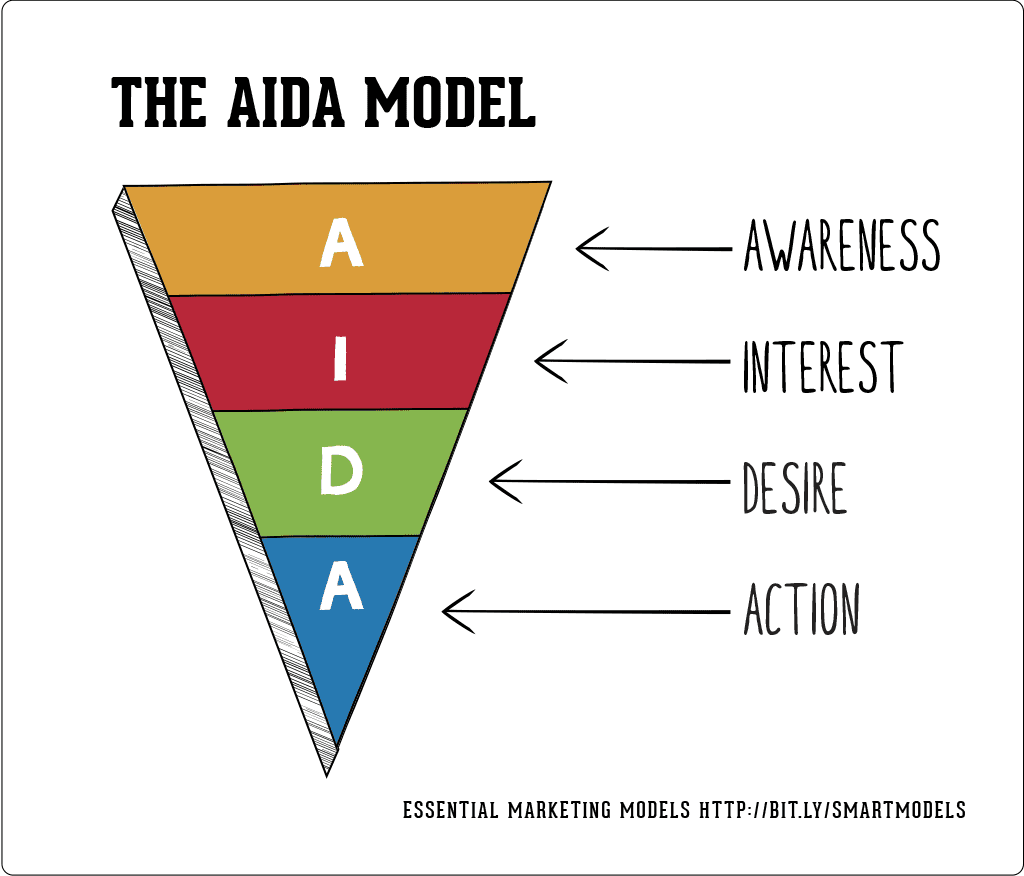
The AIDA model, tracing the customer journey through Awareness, Interest, Desire and Action, is perhaps the best-known marketing model amongst all the classic marketing models.
Many marketers find AIDA useful since we apply this model daily, whether consciously or subconsciously, when we're planning our marketing communications strategy.
What is the AIDA model?
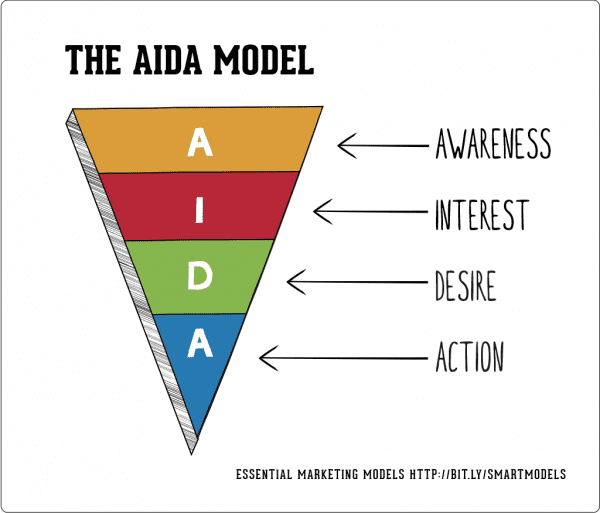
The AIDA Model identifies cognitive stages an individual goes through during the buying process for a product or service. It's a purchasing funnel where buyers go to and fro at each stage, to support them in making the final purchase.
It's no longer a relationship purely between the buyer and the company since social media has extended it to achieving the different goals of AIDA via information added by other customers via social networks and communities.
What does AIDA stand for?
- Awareness: creating brand awareness or affiliation with your product or service.
- Interest: generating interest in the benefits of your product or service, and sufficient interest to encourage the buyer to start to research further.
- Desire: for your product or service through an 'emotional connection', showing your brand personality. Move the consumer from 'liking' it to 'wanting it'.
- Action: CTA - Move the buyer to interact with your company and taking the next step ie. downloading a brochure, making the phone call, joining your newsletter, or engaging in live chat, etc.
- Retention: We all know that this is key to upsell, cross-sell, referrals, Advocacy and the list goes on.. as companies are also focussing on LTV.
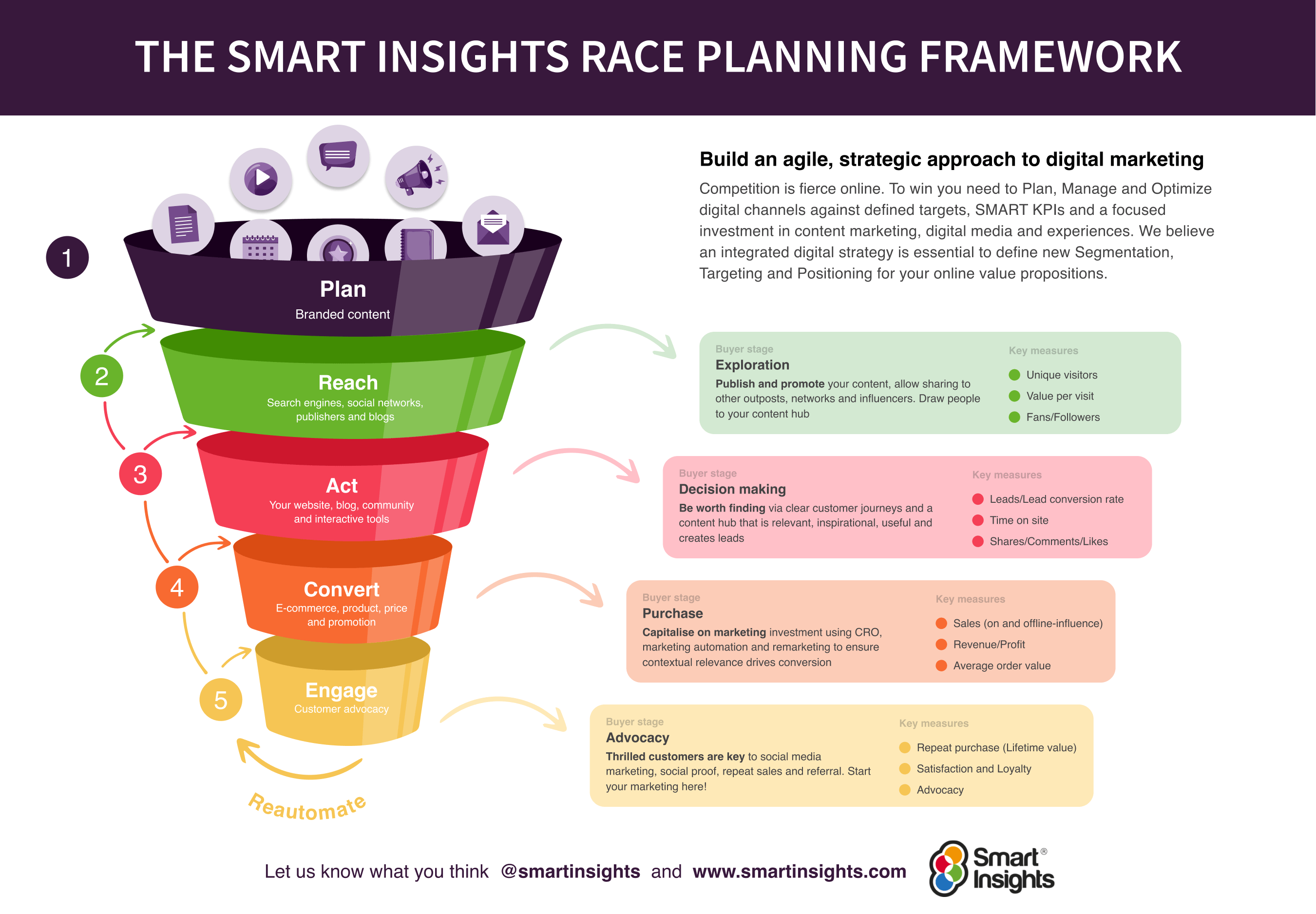
The additional "R" is sometimes added by some Marketers to show the importance of ongoing relationship-building to give the AIDAR model. This is similar to the 'engage' aspect of our RACE funnel.
Free digital marketing plan template
Our popular marketing planning template is structured across the Smart Insights RACE Framework. Join Smart Insights as a Free Member to download our digital marketing plan template today
Access the Digital marketing plan template
How to use the AIDA model
So how can AIDA be applied to marketing planning?
The AIDA funnel could be referred to as a communications model rather than a decision-making model. Companies use AIDA to identify how and when to communicate during each of stage of their customer journey. Consumers will be using different platforms, engaging at different touchpoints, and requiring different information throughout the stages from various sources.
So using this to help plan your tailored and targeted communication campaign may be a start.
Ask yourself some key questions throughout the stages:
- Awareness: How do we make buyers aware of our products or services? What is our outreach strategy? What is our brand awareness campaign? Which tools or platforms do we use? What should the messages be?
- Interest: How will we gain their interest? What is our content strategy? Social proof available to back up our reputation? How do we make this information available and where ? ie. on website, via videos, customer ratings,
- Desire: What makes our product or service desirable? How do we interact personally to make an emotional connection? Online chat? Immediate response to Twitter feed? Share tips and advice?
- Action: What are the call to actions and where do we place them? Is it easy for consumers to connect and where would they expect to find it? Think about which marketing channel/platform you are using and how to engage ie. across emails, website, landing pages, inbound phone calls etc.
- Retention: What is the proposition to retain loyalty? At what stage do we encourage this on-line and off-line, and how?
An example of the AIDA model
Here is a case study from our Marketing Models Guide showing how an award-winning hairdressing company, Francesco Group used the model to launch their new salon.

- 1. Awareness: Ran a PR campaign four months prior to launch, promoting award, stylists, qualifications etc. and was reinforced through a DM campaign to targeted customer groups.
- 2. Interest: Executed a direct mail campaign to offer a free consultation or hair cut and finish. They used research to support that this would work, as females are loyal if the offer is compelling.
- 3. Desire: Close to the opening of the new salon, they ran exclusive local launch events which was advertised through local press and social media. This created a local buzz for 'people wanting an invite' and excited to see the new salon.
- 4. Action: Clear CTAS were positioned on the Facebook site (call to reserve), the website (call to book) and local advertising (call in to receive discount or the offer.
The case study didn't highlight Retention, though there are many ways to increase loyalty around sign up to mailing lists or social platforms which offer news about offers and events, discounts on product ranges, discounts according to the frequency of visit, etc.
Structure your marketing plan around a funnel proven to boost performance. Join Smart Insights as a Free Member for instant access to our free digital marketing plan template to hone your skills and drive the results you need.
Free digital marketing plan template
Our popular marketing planning template is structured across the Smart Insights RACE Framework. Join Smart Insights as a Free Member to download our digital marketing plan template today
Access the Digital marketing plan template
Criticisms of the AIDA model?
Hierarchy of response frameworks such as AIDA, are often formed into funnel models to assist planning. The RACE framework is an example of a funnel model. Since these models are linear, they have been criticized for this, since commentators believe they are an oversimplification and don't reflect the non-linear nature of decision-making.
Recently, BCG in their 2025 article, It’s Time for Marketers to Move Beyond the Linear Funnel, also asserted that we need to move beyond the linear marketing funnel model to what they called 'influence maps'. Read our article What is the best digital marketing / marketing framework? for further discussion.
The Original Reference Source
Some say the AIDA model has been used for over three centuries. More details on the AIDA model history are available on Wikipedia.
Lewis, E. St. Elmo. (1899) Side Talks about Advertising. The Western Druggist. (21 February). p. 66. Lewis, E. St. Elmo.
(1903) Advertising Department. The Book-Keeper. (15 February).
p. 124. Lewis, E. St. Elmo. (1908) Financial Advertising, Indianapolis: Levey Bros. & Company.